

This free Pregnancy Calculator estimates your expected delivery date, current gestational weeks, and trimester milestones privately inside your browser. You can use the tool as a pregnancy calculator due date planner from your last menstrual period, a pregnancy calculator weeks and months tracker, an ivf pregnancy calculator, or a pregnancy calculator by ultrasound using clinician-supplied scan measurements. Above all, remember that an online calculator provides an educational calendar estimate only—it never confirms pregnancy or replaces obstetric care.
What Is a Pregnancy Calculator?
A Pregnancy Calculator translates standard obstetric dating rules into a 40-week (280-day) calendar timeline. After a missed cycle—when users often look up a missed period pregnancy calculator—expectant parents want to know how many weeks pregnant they may be and which trimester comes next. However, only a clinical beta-hCG test or diagnostic examination by a qualified healthcare professional can confirm pregnancy. Similarly, home test devices (sometimes searched alongside terms like clearblue pregnancy calculator; note that JammuUniversity.in has zero affiliation with Clearblue or any test brand) measure urinary hCG thresholds rather than definitive clinical gestational dates.
How a Pregnancy Calculator Estimates Due Dates
Obstetric guidelines from the American College of Obstetricians and Gynecologists (ACOG) define full-term singleton gestation as 280 days (40 weeks). Specifically, clinicians count those 280 days from the first day of the Last Menstrual Period (LMP), assuming a 28-day cycle.
However, many regular cycles run shorter or longer than 28 days. Therefore, our pregnancy calculator due date mode adds 280 + (Cycle Length − 28) days when you estimate your due date. Even so, irregular cycles are dated far more reliably using clinical medical dating information from an early scan.
Pregnancy Weeks and Months Explained
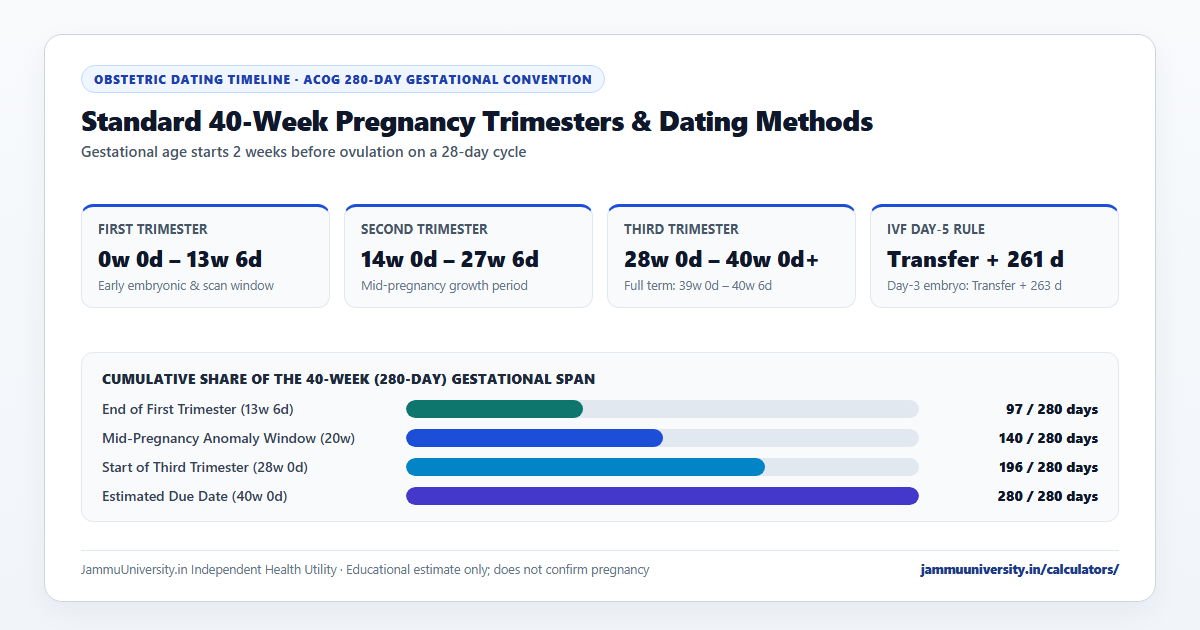
Clinicians track gestation in completed weeks and days (such as 12 weeks, 4 days) rather than calendar months. Four weeks equal 28 days, whereas most calendar months last 30 or 31 days. In our pregnancy calculator weeks and months tracker, weeks and trimester divisions follow standard obstetric rules:
- First Trimester: Week
0w 0dthrough13w 6d(roughly Months 1 to 3). - Second Trimester: Week
14w 0dthrough27w 6d(roughly Months 4 to 6). - Third Trimester: Week
28w 0dthrough40w 0dand birth (full term spans39w 0d–40w 6d).
LMP vs Conception Date
First-time parents often wonder why they are “4 weeks pregnant” just two weeks after conceiving! Gestational age starts on Day 1 of your last period, roughly 14 days before ovulation. When you select Mode 2 (an ovulation and pregnancy calculator or conception date pregnancy calculator), the tool adds 266 days to conception. Because sperm survival and ovulation vary by several days, natural conception dates remain estimates without clinical tracking.
IVF Pregnancy Due Date
Assisted reproductive cycles provide exact laboratory timestamps. In Mode 3, our ivf pregnancy calculator computes your ivf due date using ACOG standards:
- Day-5 Blastocyst Transfer:
EDD = Transfer Date + 261 days(since266 − 5 = 261; gestational age equals2w 5don transfer day). - Day-3 Cleavage Embryo Transfer:
EDD = Transfer Date + 263 days(266 − 3 = 263; gestational age equals2w 3don transfer day).
Ultrasound Pregnancy Dating
First-trimester crown-rump length (CRL) biometry up to 13w 6d is the most accurate clinical method for establishing or revising an estimated due date. Importantly, an online tool cannot interpret raw ultrasound images on its own. Instead, Mode 4 (pregnancy calculator by ultrasound) requires concrete clinical dating inputs from your sonography report—either the clinician-assigned Ultrasound EDD, or the exact scan date paired with the measured gestational weeks and days—and refuses to guess when those clinical figures are missing.
Twin Pregnancy Considerations
Parents searching for twin pregnancy calculator weeks should know a vital clinical distinction: while twin gestations still track gestational age on the exact same 40-week obstetric calendar as singletons, twins very often deliver earlier than 40 weeks depending on chorionicity and amnionicity (dichorionic vs. monochorionic twins). Consequently, no generic single-date formula should ever predict an actual twin delivery date; your maternal-fetal specialist or obstetrician determines individualized monitoring and delivery timing.
Pregnancy Calculator FAQs
1. How many babies actually arrive on their exact Estimated Due Date?
Only around 4% to 5% of spontaneous singleton births occur on the exact 40w 0d date. Most uncomplicated full-term births happen within two weeks before or one week after the EDD.
2. Should I change my due date every time I have a later ultrasound?
No. Once an official EDD is confirmed by your obstetrician (ideally in the first trimester), later second- and third-trimester scans assess fetal growth rather than redating the pregnancy.
3. Does this calculator store my LMP, IVF, or ultrasound dates?
Never. All date math runs locally in your browser memory and disappears as soon as you close or refresh the tab.
4. When should I contact a doctor immediately instead of using an online tool?
Seek prompt medical care for any pelvic pain, bleeding, dizziness, reduced fetal movement, fever, or high blood pressure at any stage of pregnancy.
Medical & Editorial Disclaimer: Published by JammuUniversity.in, an independent news and public-utility publication (unaffiliated with the University of Jammu, ACOG, Clearblue, or any hospital). Methodology follows public ACOG Committee Opinion No. 700 conventions and was prepared for educational reference—not clinical diagnosis or obstetric advice. Always consult a qualified OB-GYN or midwife. Browse more tools in our calculators directory.