

This free Calorie Calculator estimates resting metabolism and total daily energy needs for non-pregnant adults aged 18 and older. Using the peer-reviewed Mifflin-St Jeor equation, our tool serves as a tdee calorie calculator, a calorie calculator maintenance planner, a daily calorie intake calculator, and an optional macro and calorie calculator in metric or imperial units. Built-in clinical guardrails prevent unsafe extreme-deficit targets and keep every input private inside your browser.
What Is a Calorie Calculator?
A kilocalorie (written simply as “calorie” or kcal on food labels) fuels breathing, circulation, cellular repair, and movement. Direct laboratory calorimetry requires specialized metabolic chambers. Instead, dietitians estimate adult baseline energy needs with validated formulas like the Mifflin-St Jeor (1990) equation and NIH Body Weight Planner.
However, general adult formulas do not apply to children or teens under 18. Similarly, pregnant or breastfeeding mothers and patients with metabolic or eating disorders need individualized medical care rather than a general bmr and calorie calculator.
BMR and TDEE Explained
Separating BMR (Basal Metabolic Rate—sometimes mistyped online, whereas clinically BMR means resting metabolism and BMD means bone mineral density) from TDEE prevents extreme under-eating:
- Basal Metabolic Rate (BMR): The energy your organs burn at complete waking rest:
Male BMR = (10 × kg) + (6.25 × cm) − (5 × age) + 5Female BMR = (10 × kg) + (6.25 × cm) − (5 × age) − 161 - Total Daily Energy Expenditure (TDEE): Your resting BMR multiplied by an activity factor (
1.2to1.9) to estimate daily calorie needs across work, walking, and exercise.
Note that an activity multiplier in a tdee calorie calculator is a lifestyle average. It does not measure exact calories burned during a single exercise workout, which depends on heart rate and effort.
Daily Calorie Needs
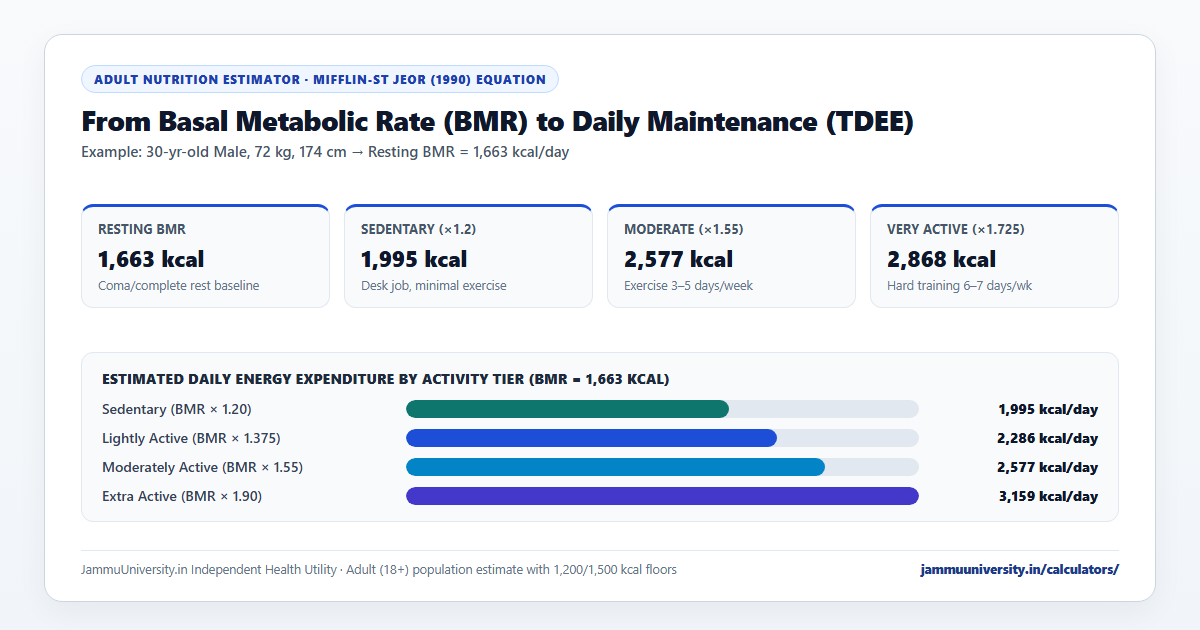
Let us trace a complete example in our daily calorie intake calculator. Suppose a 30-year-old man weighs 72 kg, stands 174 cm tall, and exercises 3 to 5 days per week (Moderately Active, ×1.55). First, his resting BMR equals (10 × 72) + (6.25 × 174) − (5 × 30) + 5 = 720 + 1,087.5 − 150 + 5 = 1,663 kcal/day. Multiplying by 1.55 gives an estimated TDEE of 2,577 kcal/day. You can pair this energy estimate with height-for-weight screening context in our adult Body Mass Index tool.
Maintenance Calories
Your calorie calculator maintenance number equals your estimated TDEE—the approximate average intake at which body weight stays broadly stable over several weeks. Because predictive equations carry an inherent individual variance of roughly ±10% due to genetics, lean muscle mass, and non-exercise fidgeting (NEAT), treat your TDEE as a starting baseline and adjust gradually based on 3-to-4-week real-world trends.
Calorie Deficit Basics
Adults researching a calorie calculator weight loss or calorie deficit calculator target typically subtract 250 to 500 kcal/day below maintenance TDEE rather than eating below resting BMR. Aggressive crash diets trigger fatigue, lean-muscle loss, and micronutrient shortfalls. Therefore, our daily energy planner enforces strict automatic floors—never outputting routine targets below 1,200 kcal/day (female parameter) or 1,500 kcal/day (male parameter) without displaying a clinical supervision warning.
Calories for Muscle Gain
Strength trainees using a calorie calculator bodybuilding approach combine progressive resistance training with a modest +250 to +500 kcal/day surplus above maintenance TDEE. A controlled +250 kcal lean-gain surplus supports muscle protein synthesis while limiting unnecessary fat accumulation.
Macro Calculator Basics
Calories come from three primary macronutrients: Protein (4 kcal/g), Carbohydrates (4 kcal/g), and Dietary Fat (9 kcal/g). Our optional macro and calorie calculator selector converts your daily target into grams under three transparent example splits: Balanced (30% P / 40% C / 30% F), Higher Protein (35% P / 40% C / 25% F), and Low-Carb / keto calorie calculator style (25% P / 5% C / 70% F). Ketogenic or therapeutic diets are unsuitable for several medical conditions and medications, so consult your physician first.
Calorie Calculator FAQs
1. Should I eat fewer calories than my BMR to lose weight faster?
Consistently eating below resting BMR without medical supervision is generally discouraged because BMR represents the baseline energy needed for vital organ function at rest.
2. Why is Mifflin-St Jeor used instead of the older Harris-Benedict formula?
Validation reviews by the Academy of Nutrition and Dietetics found Mifflin-St Jeor (1990) predicted resting metabolic rate within 10% of measured values more consistently in modern adult populations than the 1919 Harris-Benedict equation.
3. Why does this adult calorie estimator require age 18 or older?
Growing children and adolescents require additional energy for linear growth and puberty, so adult TDEE deficits should never be applied to users under 18.
4. Does this page store my weight, age, or nutrition goals?
No. Every computation executes privately inside your browser with zero server transmission.
Medical & Nutrition Disclaimer: Published by JammuUniversity.in, an independent news and public-utility portal (not affiliated with the NIH, University of Jammu, or any clinic). Estimates are general adult educational calculations, not individualized medical or dietetic advice. Consult a physician or registered dietitian before starting any calorie deficit or ketogenic diet. Explore all tools in our calculators hub.