

Our free Percentage Calculator solves ten everyday ratio problems in one clean interface, showing both the instant answer and the step-by-step equation. You can use this percentage calculator online as a percentage increase calculator, a student marks percentage calculator, or a percentage change calculator for business and shopping math. Every mode handles decimals, negative inputs, and zero-denominator checks cleanly inside your browser.
What Is a Percentage Calculator?
The word percent comes from the Latin per centum, meaning “out of one hundred.” A Percentage Calculator converts raw fractions and value shifts onto a common 100-point scale so you can compare exam scores, tax invoices, salary hikes, and retail discounts effortlessly. Instead of forcing you to open separate pages for every variation, our 10-in-1 math percentage calculator lets you switch modes with one click while displaying the exact algebraic formula underneath each result.
How to Calculate Percentage
When you want to find percentages of a quantity or find percentage of two numbers, two core equations handle most daily tasks:
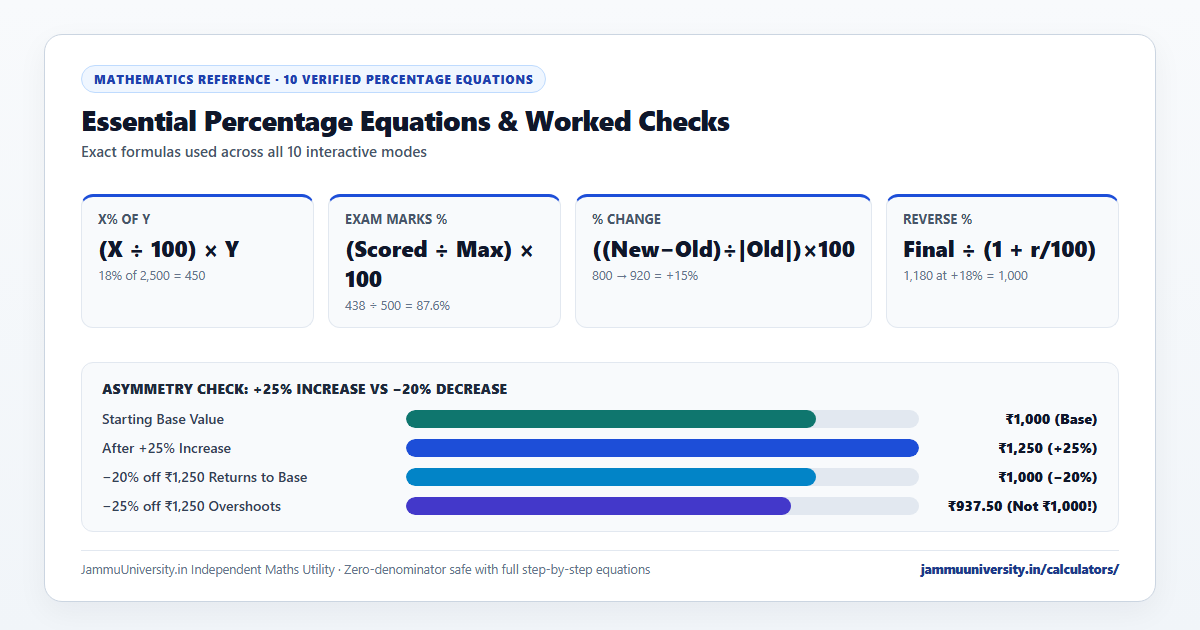
- Find X% of Y: Multiply the base number by the rate divided by 100:
Result = (X ÷ 100) × Y. For example,18% of 2,500 = 450. - Find What Percentage X Is of Y: Divide the part by the whole and multiply by 100:
Percentage = (X ÷ Y) × 100. For instance,432 out of 600 = 72%.
Select any mode pill in our percentage calculator online above. Next, type your two numbers to inspect the live equation and verify every percentage increase or decrease.
Percentage Increase Formula
Whenever a price, tuition fee, or stipend grows from an earlier baseline, our percentage increase calculator and signed percentage change calculator apply one clear formula:
Percentage Change = ((New Value − Old Value) ÷ |Old Value|) × 100
For example, suppose an electricity bill rises from ₹1,600 to ₹1,960. The ₹360 jump divided by ₹1,600 equals +22.5% across all percentage changes. If the starting baseline is zero, division by zero is undefined. Therefore, the tool displays a clear warning instead of infinity.
In addition, Mode 9 computes symmetric Percentage Difference—(|A − B| ÷ ((|A| + |B|) ÷ 2)) × 100—which uses the average of two positive measurements when neither number is chronologically “older” than the other.
Percentage Decrease Formula
When a quantity drops from a starting value to a smaller value, the percentage decrease calculator mode measures the drop relative to the original starting number:
Percentage Decrease = ((Old Value − New Value) ÷ |Old Value|) × 100
Suppose a laptop’s price falls from ₹50,000 to ₹42,500. The ₹7,500 reduction divided by ₹50,000 equals a 15% decrease. Keep in mind that percentages are asymmetric: increasing ₹1,000 by 25% produces ₹1,250, and returning from ₹1,250 back to ₹1,000 requires a 20% decrease (250 ÷ 1,250), not 25%.
Marks Percentage Calculator
Board candidates, university undergraduates, and competitive exam aspirants regularly need an accurate marks percentage calculator to fill out scholarship and admission portals. Choose Mode 8 (Exam Marks Percentage), enter your aggregate marks scored across all subjects in Field A, and enter the combined maximum marks in Field B:
Exam Percentage = (Total Marks Obtained ÷ Maximum Possible Marks) × 100
For example, scoring 438 out of 500 across five papers yields (438 ÷ 500) × 100 = 87.60%, leaving a margin of 62 marks below the maximum. If your university transcript lists semester credit points instead of raw marks, use our semester & CGPA grade calculator to check credit-weighted averages alongside institutional conversion rules.
Discount and Reverse Percentage Examples
Shoppers and small-business owners frequently confuse forward discounts with tax-inclusive reverse calculations:
- Retail Discount (Mode 6 – Percentage Discount Calculator): On a jacket listed at ₹2,499 with a 20% discount, you save
2,499 × 0.20 = ₹499.80and pay ₹1,999.20. - Pre-Tax Invoice Check (Mode 7 – Reverse Percentage Calculator): Suppose a restaurant or electronics receipt shows ₹1,180 inclusive of 18% GST. Subtracting 18% of ₹1,180 (
₹212.40) is wrong because GST was added onto the smaller pre-tax price! Instead, divide by1 + 0.18:1,180 ÷ 1.18 = ₹1,000original price and₹180tax. Similarly, if ₹850 is the sale price after a 15% discount, enter-15in Mode 7 to recover850 ÷ 0.85 = ₹1,000.
When percentage rates compound monthly over multi-year bank loans rather than applying once, switch to our monthly loan repayment tool to see reducing-balance interest accurately.
Percentage Calculator FAQs
1. What is the difference between percentage change and percentage difference?
Percentage change compares a new value against a specific starting (old) baseline, whereas percentage difference divides the absolute gap between two peer numbers by their arithmetic mean.
2. How do I remove 18% GST from a tax-inclusive price?
Open Mode 7 (Reverse Percentage), enter the final bill amount in the first box, and enter 18 in the second box. Dividing by 1.18 gives the exact pre-tax base amount.
3. Why can’t you calculate percentage increase from zero?
The percentage change formula divides by the original baseline value. When the starting value is 0, division by zero is undefined in arithmetic.
4. Can I enter decimal marks or negative percentages?
Yes. Every input field accepts decimals (such as 8.25% or 74.5 marks) as well as signed values where mathematically valid.
Editorial Note: Published by JammuUniversity.in, an independent news and educational tools publication (not affiliated with the University of Jammu). Standard mathematical conventions align with OpenStax Prealgebra reference definitions. View all tools in our calculators hub.