

Our free BMI Calculator lets adults aged 20 and older check their weight-to-height ratio in seconds. Whether you use this body mass index calculator as an adult bmi calculator, a metric bmi calculator kg and cm, or a healthy bmi calculator in pounds and feet, every calculation runs privately in your browser. In addition, the tool clearly explains standard public-health categories and safeguards users under age 20 from misleading adult labels.
What Is BMI?
Body Mass Index (BMI)—originally formulated as the Quetelet index in the nineteenth century—is a simple numerical ratio derived from a person’s body weight and standing height. Public health agencies such as the World Health Organization (WHO) and the U.S. Centers for Disease Control and Prevention (CDC) use BMI as an inexpensive population-level screening metric.
However, BMI is a screening ratio rather than a medical diagnosis. Specifically, an accurate bmi calculator measures weight relative to height squared, not actual subcutaneous or visceral body fat, bone mineral density, hydration, or lean skeletal muscle.
How to Calculate BMI With Our BMI Calculator
You can calculate body mass index in our BMI Calculator using either metric or imperial measurements:
- Choose Metric or Imperial Units: Keep Metric (kg / cm) selected to use the bmi calculator kg and cm sliders, or switch to Imperial (lb / ft·in) for pounds, feet, and inches.
- Enter Weight and Height: Drag the synchronized sliders or enter height and weight in kg/cm directly. Realistic bounds prevent impossible typos.
- Enter Age for Proper Interpretation: For ages 20 and above, this healthy bmi calculator maps your score onto standard adult bmi categories. Conversely, for ages 2 to 19, the tool suppresses adult obesity labels and explains pediatric percentile evaluation.
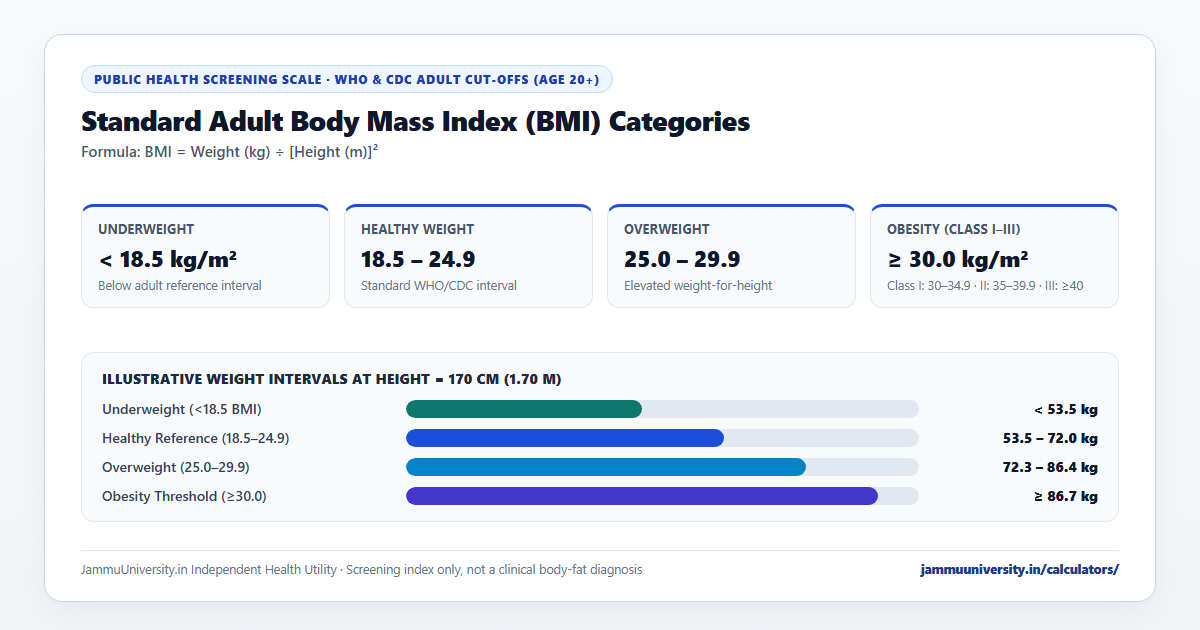
BMI Formula With Examples
Both measurement systems convert to the identical underlying ratio:
- Metric Formula:
BMI = Weight (kg) ÷ [Height (m)]², whereHeight (m) = Height (cm) ÷ 100. - Imperial Formula:
BMI = 703 × Weight (lb) ÷ [Height (in)]², where1 foot = 12 inches.
Worked Metric Example (kg and cm)
Suppose an adult weighs 68 kg and stands 170 cm tall. First, convert centimetres to metres: 170 ÷ 100 = 1.70 m. Next, square the height: 1.70 × 1.70 = 2.89 m². Finally, divide weight by squared height: 68 ÷ 2.89 = 23.53 kg/m², which rounds to 23.5 kg/m² (within the 18.5–24.9 adult reference interval).
Worked Imperial Example (lb, ft, and in)
Suppose an adult weighs 165 lb at a height of 5 ft 9 in. First, convert height to total inches: (5 × 12) + 9 = 69 inches. Next, square the inches: 69² = 4,761. Applying the conversion factor gives (703 × 165) ÷ 4,761 = 115,995 ÷ 4,761 = 24.36, or 24.4 kg/m².
Adult BMI Categories
For non-pregnant adults aged 20 years and older, global WHO and CDC screening guidelines (often searched as a cdc bmi calculator table) define four primary intervals:
- Below 18.5 kg/m²: Underweight screening category.
- 18.5 to 24.9 kg/m²: Healthy Weight (normal adult reference interval).
- 25.0 to 29.9 kg/m²: Overweight screening category.
- 30.0 kg/m² and above: Obesity screening category, subdivided into Class I (
30.0–34.9), Class II (35.0–39.9), and Class III (≥ 40.0).
Alongside your category, our healthy bmi calculator multiplies 18.5 × m² and 24.9 × m² to show the approximate weight span corresponding to the standard reference interval for your height. Remember that this span is a statistical reference, not a personalized “ideal weight bmi calculator” prescription. If you are planning nutrition adjustments with a clinician or dietitian, you can also review daily energy expenditure in our daily calorie & TDEE estimator.
BMI for Men and Women
People frequently search separately for a bmi calculator for women and a bmi calculator for men. Mathematically, standard adult public-health tables apply the exact same formula and cut-off thresholds (18.5, 25.0, 30.0) to both adult men and adult women. Biologically, however, women naturally carry a higher essential body-fat percentage than men at the exact same BMI, whereas strength-trained men or female athletes may cross 25.0 kg/m² purely from dense lean muscle. Therefore, clinicians evaluate waist circumference, blood pressure, lipid panels, and fasting glucose alongside your body mass index calculator reading.
BMI for Children and Teenagers
If you are looking for a bmi calculator for kids or adolescents aged 2 to 19, fixed adult cut-offs must never be used. During childhood and puberty, healthy body composition changes every single month and differs between boys and girls. Pediatricians compute the raw kg/m² number first, and then plot it on official WHO or CDC BMI-for-age sex-specific percentile growth charts (where the 5th to under-85th percentile represents healthy growth). Whenever an age under 20 is entered above, our BMI Calculator disables adult labels and directs families to age-and-sex percentile charts or a pediatrician.
BMI Limitations and Accuracy
- Muscle vs. Fat Blindness: Athletic users with high skeletal muscle mass can register in the overweight range despite low body fat.
- Age-Related Sarcopenia: Older adults who lose muscle mass may fall inside 18.5–24.9 while still carrying elevated abdominal adiposity.
- Ethnic Risk Nuances: Epidemiological studies in South Asian populations note that cardiometabolic risk can rise at lower BMI levels than in European cohorts; always ask your physician how regional clinical guidelines apply to you.
- Pregnancy Exclusion: Standard adult BMI categories do not apply during pregnancy.
BMI Calculator FAQs
1. Does a BMI Calculator measure my body fat percentage?
No. BMI only compares total body weight against height squared. Measuring actual body fat requires clinical or physiological methods such as DEXA scans, skinfold calipers, or bioelectrical impedance.
2. Is the BMI formula different for men and women?
No. For adults aged 20 and above, both the mathematical equation and standard WHO/CDC category boundaries are identical for men and women.
3. Why shouldn’t teenagers use adult BMI categories?
Because height, bone mass, and lean tissue change rapidly before age 20, pediatric BMI must be interpreted against official age- and sex-specific growth percentiles rather than fixed adult cut-offs.
4. Are my height and weight saved when I calculate BMI here?
No. All calculations happen locally in your browser window, and zero health inputs are sent to our servers.
Medical Disclaimer: This page is published for general educational screening by JammuUniversity.in (an independent digital publication unaffiliated with the WHO, CDC, or University of Jammu). It is not medical advice or a clinical diagnosis. Consult a qualified physician or registered dietitian before changing your diet or exercise routine. See more tools in our calculators hub.