

Our free Compound Interest Calculator shows how lump-sum deposits and regular additions grow when earned interest is reinvested each period. You can switch between a compound interest calculator daily mode, a compound interest calculator monthly mode, a quarterly savings compound interest calculator, or a multi-decade investment compound interest calculator in one click. In addition, the interactive table exports a complete year-by-year breakdown to CSV.
What Is Compound Interest?
Compound interest means earning interest on both your original principal and previously credited interest. Under simple interest, ₹1,00,000 at 8% earns ₹8,000 every single year. Conversely, with savings compounding and investments compounding, Year 1’s ₹8,000 gain joins your principal base. Therefore, Year 2 earns 8% on ₹1,08,000 (₹8,640), accelerating long-term growth.
Investors also frequently look up a cagr calculator. Remember one key difference: CAGR expresses an asset’s multi-year return as one smoothed annual rate (n = 1). Meanwhile, bank deposits quote a nominal rate with quarterly, monthly, or daily compounding, yielding a higher Effective Annual Rate (EAR).
Compound Interest Formula
For an initial lump-sum principal without recurring deposits, textbook financial mathematics (see the U.S. SEC Investor.gov compounding reference) uses:
A = P × (1 + r ÷ n)^(n × t)
A: Final future value including accrued interest.P: Starting principal amount.r: Nominal annual interest rate expressed as a decimal (for example,8% = 0.08).n: Compounding periods per year—365(daily),12(monthly),4(quarterly),2(half-yearly), or1(annually).t: Duration in years, with Effective Annual Rate given byEAR = (1 + r ÷ n)ⁿ − 1.
Daily vs Monthly Compounding
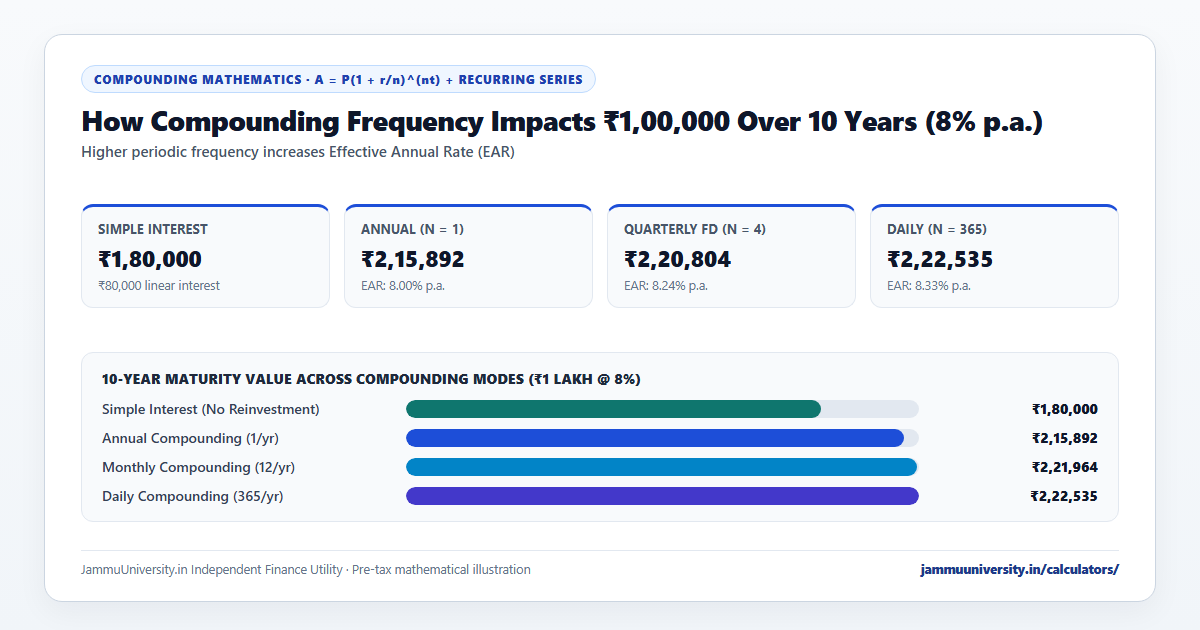
When savers compare a compound interest calculator daily schedule against a compound interest calculator monthly schedule at the same 8.00% nominal rate on ₹1,00,000 for 10 years, the mathematical difference is transparent:
- Monthly Compounding (
n = 12):A = 1,00,000 × (1 + 0.08/12)¹²⁰ = ₹2,21,964(EAR = 8.30%). - Daily Compounding (
n = 365):A = 1,00,000 × (1 + 0.08/365)³⁶⁵⁰ = ₹2,22,535(EAR = 8.33%).
Notice that jumping from annual (₹2,15,892) to monthly adds ₹6,072, whereas jumping from monthly to daily adds ₹571 because periodic subdivisions approach Euler’s continuous limit asymptotically.
Compound Interest With Monthly Contributions
Real households rarely invest a single lump sum and stop. Therefore, our tool also functions as a compound interest calculator with monthly contributions that separates starting principal growth from recurring monthly deposits. Using the exact equivalent monthly yield rₘ = (1 + r/n)^(n/12) − 1, each monthly deposit compounds according to whether you select End of month (ordinary annuity) or Beginning of month (annuity due, which earns one extra month of compounding on every contribution). You can also pick an optional Start date to label calendar years across your projection.
For example, starting with ₹1,00,000 plus ₹2,000 at the end of every month at 8% p.a. compounded monthly for 10 years invests ₹3,40,000 total and grows to ₹5,87,856 (earning ₹2,47,856 in interest). If you are specifically comparing market-linked equity mutual funds with step-up percentages and inflation adjustments, open our dedicated monthly mutual fund SIP planner.
FD and RD Examples
In India, cumulative bank Fixed Deposits (often checked in an fd compound interest calculator) typically compound quarterly (n = 4). Under that convention, an illustrative ₹2,00,000 cumulative FD at 7.20% p.a. for 5 years grows to 2,00,000 × (1 + 0.072/4)²⁰ = ₹2,85,750 before TDS or income tax.
Similarly, an illustrative compound interest calculator recurring deposit check—depositing ₹5,000 at the beginning of each month at 7.00% p.a. with quarterly compounding (n = 4) for 3 years (36 months)—invests ₹1,80,000 and matures at approximately ₹2,00,649. Always verify your bank’s exact day-count and rounding convention on its official deposit receipt.
Compound Interest vs Simple Interest
Over short spans like six months, simple and compound interest look nearly identical. Over 15 or 25 years, however, a savings compound interest calculator and investment compound interest calculator reveal dramatic divergence: ₹1,00,000 at 9% for 20 years reaches ₹2,80,000 under simple interest, yet reaches ₹5,60,441 under annual compounding—more than double!
Compound Interest FAQs
1. Which compounding frequency is standard for Indian bank FDs?
Most cumulative retail Fixed Deposits in Indian commercial banks compound quarterly (4 times per year), whereas savings-account balances are typically calculated on daily end-of-day balances and credited quarterly.
2. Does beginning-of-month vs end-of-month contribution timing change results?
Yes. Investing at the beginning of each month gives every instalment one additional month of compounding, increasing final maturity value by one monthly rate factor (1 + rₘ) on the contribution stream.
3. Does this compounding estimator deduct TDS or income tax?
No. Results represent pre-tax mathematical projections because tax slabs, Section 80TTA/80TTB exemptions, and capital-gains rules depend on your individual tax profile.
4. Is nominal interest rate the same as Effective Annual Rate (EAR)?
They match only when compounding happens once a year (n = 1). Whenever interest compounds semi-annually, quarterly, monthly, or daily, EAR exceeds the nominal rate.
Financial Disclaimer: Published by JammuUniversity.in, an independent news and utility portal (unaffiliated with the University of Jammu or any bank). Projections are illustrative mathematical estimates, not guaranteed investment returns or tax advice. Browse more utilities in our online calculators hub.