

PM Modi Calls India ‘Mother of Democracy’ Amid Delhi Protests
New Delhi, October 14, 2026: Prime Minister Narendra Modi’s remarks describing India as the “mother of democracy” have drawn attention amid continuing protests in the national capital over alleged irregularities in electoral rolls and demands for the resignation of Chief Election Commissioner (CEC) Gyanesh Kumar.
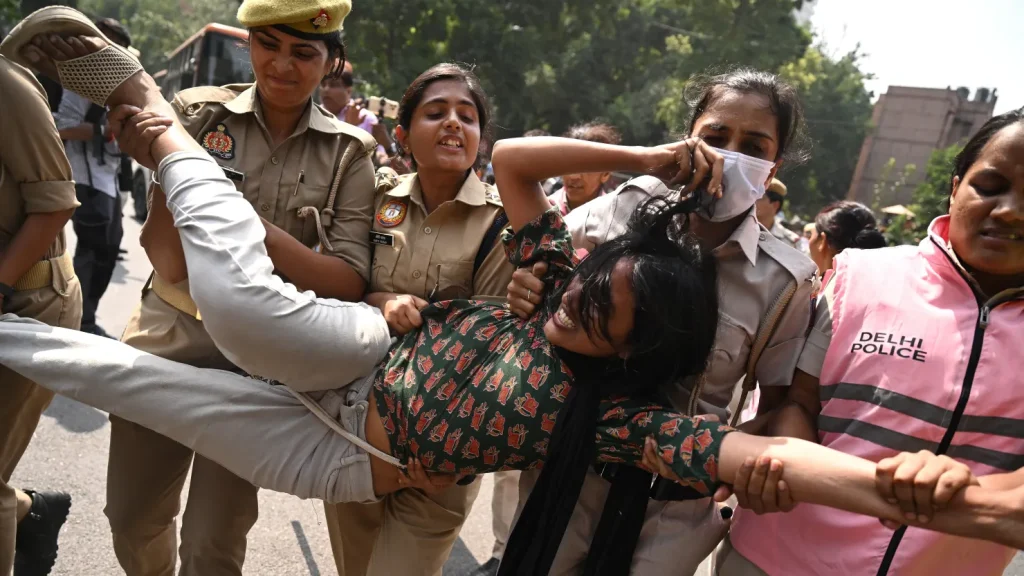
Speaking at the Bloomberg New Economy Forum in New Delhi on Tuesday, October 13, Modi highlighted India’s democratic traditions, public debate and growing digital participation. His comments came as police detained several members of the Cockroach Janta Party (CJP) who attempted to demonstrate at Jantar Mantar.
The developments have brought two major issues into focus: the controversy surrounding the Election Commission’s Special Intensive Revision (SIR) of voter lists and the restrictions imposed on public demonstrations in Delhi.
PM Modi Highlights India’s Democratic Traditions
Addressing international business leaders and policymakers at the Bloomberg New Economy Forum, Prime Minister Modi described India’s democratic identity as a source of strength.
He pointed to the country’s linguistic diversity, extensive media network and rapidly expanding digital platforms as examples of public participation and open discussion.
Modi said that India has more than 100 languages, approximately 80,000 registered newspapers and publications, and over 1,000 satellite television channels.
He also highlighted the country’s large social media audience, saying that more than 500 million people use YouTube and a similar number use Instagram.
The Prime Minister emphasized that technology has made information, education and economic opportunities more accessible to ordinary citizens.
His wider message focused on using technology and government authority to empower people rather than concentrating opportunities among a limited section of society.
Although the speech was not presented as a direct response to the ongoing electoral protests, its timing brought renewed attention to the debate over democratic participation and the right to peaceful dissent.
CJP Leaders Detained During Jantar Mantar Protest
Tensions continued in central Delhi on Tuesday when members of the Cockroach Janta Party attempted to enter Jantar Mantar despite police barricades and restrictions.
CJP leaders Saurav Das, Ashutosh Ranka and Ajinkya Shinde were among those detained during the demonstration.
The activists carried the Indian national flag and raised slogans while demanding accountability from the Election Commission over disputed voter-list revisions.
CJP founder Abhijeet Dipke shared details of the detentions on social media and criticized the restrictions on demonstrations.
The latest police action followed a weekend of protests during which thousands of demonstrators were detained in Delhi.
On October 10, Dipke and other senior CJP leaders were detained shortly after arriving in the capital. They were subsequently released following court proceedings.
The protests have also attracted participation from student organizations, opposition supporters and civil society groups.
Why Has Jantar Mantar Been Removed as a Protest Site?
Jantar Mantar, one of Delhi’s most recognizable locations for public demonstrations, was removed from the list of officially designated protest sites on October 12.
Delhi Police identified three alternative venues where demonstrations can be organized:
- Ramlila Ground
- Burari Ground
- CBD Ground in East Delhi
Authorities have maintained that regulating protest locations is necessary for public order and the management of large gatherings.
During proceedings before the Delhi High Court, the police said the decision followed Supreme Court observations concerning suitable alternative locations for peaceful demonstrations.
However, activists and opposition representatives have questioned the decision, arguing that removing Jantar Mantar’s designation restricts access to a historically important space for public protest.
The controversy has renewed discussion about the balance between citizens’ constitutional right to peaceful assembly and the responsibility of authorities to maintain public safety.
What Is the 13 Crore Voter List Controversy?
At the center of the protests is the Election Commission of India’s Special Intensive Revision, commonly known as SIR.
The exercise is intended to verify electoral records, identify ineligible or duplicate entries and improve the accuracy of voter lists.
However, its implementation has become politically contentious because of the unusually large number of names excluded from draft electoral rolls.
According to figures reported in October, approximately 13.39 crore voter entries were placed in categories covering people who were absent, had permanently relocated, were deceased, or appeared in duplicate records.
The Election Commission reported that these included approximately 6.30 crore voters classified as permanently shifted, 3.01 crore as absent or untraceable, 2.80 crore as deceased and 1.02 crore as duplicate entries, with other classifications accounting for the remaining cases.
These figures do not establish that every person identified in the revision was an eligible voter who permanently lost voting rights.
Nevertheless, opposition parties and activists have raised concerns that genuine voters may have been excluded during the verification process.
They have also alleged that some communities could face disproportionate difficulties in restoring their registrations.
The Election Commission has rejected allegations that the exercise was designed to benefit any political party.
It maintains that eligible citizens whose names are missing can seek inclusion through the prescribed claims, objections and registration procedures.
Election Commission Orders Special Enrolment Drive
Amid growing criticism, the Election Commission has taken steps to address concerns about eligible voters missing from revised electoral rolls.
In late September, the Commission instructed states and Union Territories where the SIR exercise had been completed to conduct a special enrolment drive for voters left out of the lists.
The process provides opportunities for eligible citizens to submit applications for inclusion, including through Form 6 where applicable.
The controversy now centers not only on the number of entries removed but also on how effectively eligible voters can establish their status and recover missing registrations.
Opposition parties have demanded greater transparency in the verification process, while the Election Commission has defended the exercise as necessary for maintaining accurate electoral records.
Rahul Gandhi and INDIA Bloc Approach Supreme Court
The political dispute reached the Supreme Court after Congress leader Rahul Gandhi and other leaders of the opposition INDIA alliance organized a major march in Delhi on Monday, October 12.
Thousands of supporters participated in the demonstration, calling for scrutiny of the Election Commission’s decisions and the voter-list revision process.
Opposition leaders submitted a petition seeking judicial intervention over alleged irregularities, including concerns about the functioning of the Election Commission and the removal of names from electoral records.
Among the demands were an independent investigation, greater disclosure of relevant documents and safeguards against wrongful voter deletions.
However, the Supreme Court Registry identified 14 procedural defects in the petition, preventing it from being heard as initially expected on October 13.
The petitioners’ legal team was required to address those objections before the case could proceed.
The allegations raised by the opposition have not, by themselves, established wrongdoing by the Election Commission or its officials.
Election Commission and BJP Reject Manipulation Allegations
The Election Commission has repeatedly denied accusations that electoral revisions were conducted to favor the ruling Bharatiya Janata Party.
It has maintained that correcting inaccurate voter records and removing ineligible entries are legitimate administrative responsibilities.
The BJP has also rejected the opposition’s allegations, accusing political rivals of undermining confidence in electoral institutions.
Opposition parties, meanwhile, argue that the scale of voter-list changes requires independent scrutiny and stronger safeguards for eligible citizens.
The central disagreement remains whether the verification exercise adequately protects legitimate voters while identifying inaccurate registrations.
What Happens Next?
The coming days could prove important for both the electoral controversy and the continuing demonstrations.
Opposition leaders are pursuing legal remedies, while CJP activists have indicated that their campaign over voter-list revisions and the Election Commission’s leadership will continue.
The Election Commission’s efforts to restore eligible voters to electoral rolls will also be closely watched.
Further court proceedings may help determine how the disputed revisions are reviewed and what additional safeguards, if any, are required.
For now, the developments have brought public attention to a fundamental question: how India can maintain accurate electoral records while ensuring that every eligible citizen has a fair opportunity to vote.
The answer will depend on transparent procedures, effective legal safeguards and public confidence in the institutions responsible for conducting elections.
Frequently Asked Questions
Protesters are demanding the resignation of Chief Election Commissioner Gyanesh Kumar and greater scrutiny of the Election Commission’s Special Intensive Revision of electoral rolls.
At the Bloomberg New Economy Forum on October 13, 2026, Modi called India the “mother of democracy” and highlighted public debate, linguistic diversity and digital participation.
The Cockroach Janta Party is a youth-led political protest movement associated with activist Abhijeet Dipke. It has organized demonstrations concerning electoral transparency and other public issues.
The figure refers to roughly 13.39 crore entries identified during the revision process. The Election Commission disputes the characterization that all represent permanently disenfranchised eligible voters and says eligible citizens can apply for inclusion.
As of October 14, 2026, Jantar Mantar is no longer a designated protest venue. Authorities have identified Ramlila Ground, Burari Ground and CBD Ground as alternatives.
The petition was submitted in October 2026, but the Supreme Court Registry flagged 14 procedural defects. Those objections had delayed its initial hearing.
